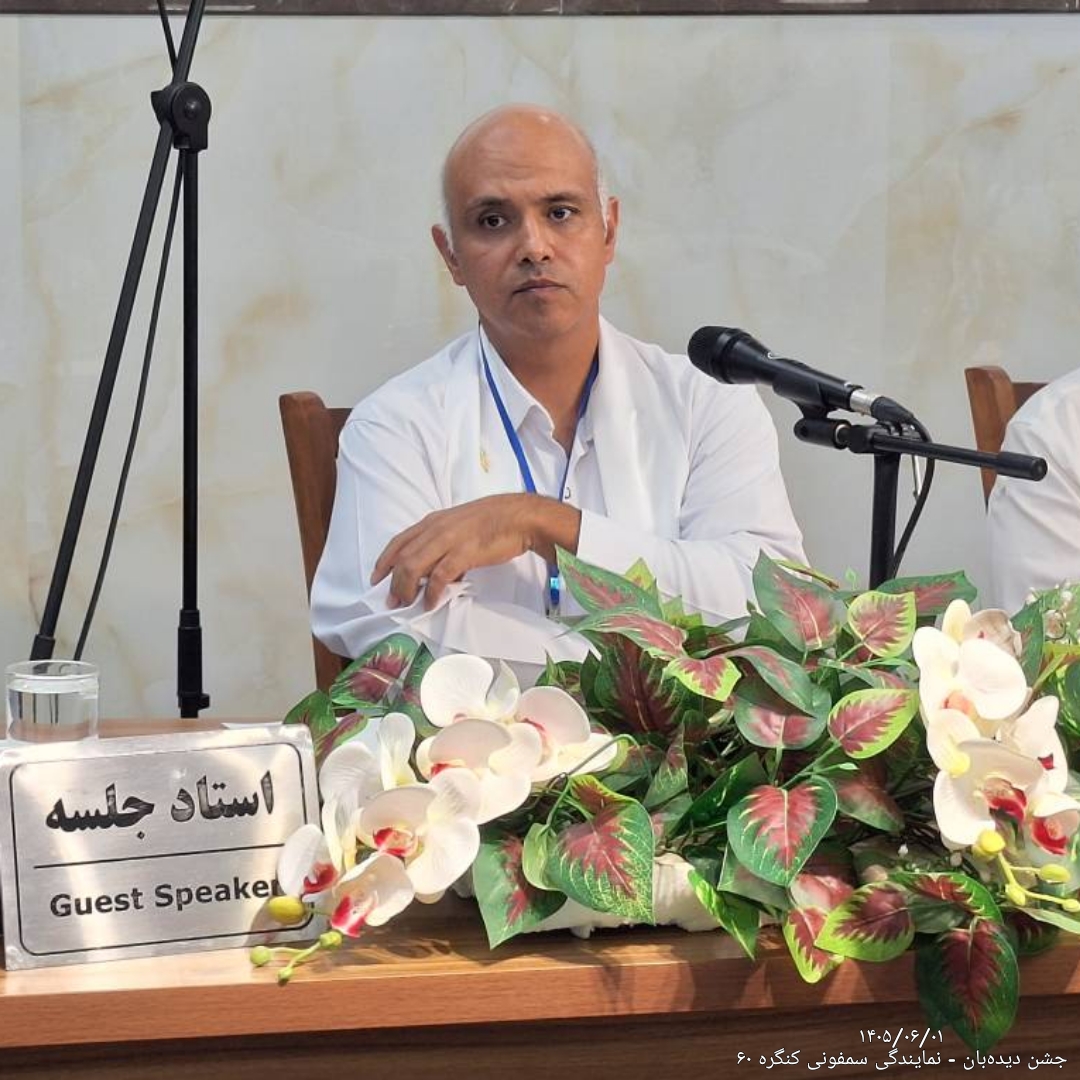
The third session of the third course of the Congress 60 educational workshop series, for travelers and Companion of the Congress 60 Symphony Branch, began promptly at 5:00 p.m. on Sunday, 01 Shahrivar 1405 (August 23, 2026). The session was led by the respected Dideban (Watcher) Dr. Amin Dezhakam, the Master of worldview, music, arboriculture, and camping. Guide Ramin, a traveler, served as the guardian, and Companion Guide Zhila served as the secretary. The agenda was "Dideban’s (Watcher’s) Week Celebration."
Dr. Amin’s Speech:
Hello friends, I’m Amin, a companion. Thank you to everyone, and I thank God that we are present at this ceremony. I hope that everyone who works in music [in the music band of Congress 60, called the Symphony Branch] can achieve something, these educations will be useful to them, and that they will have a positive impact on their lives. If that happens, we will have achieved what we wanted.
I would like to congratulate all the members of Congress 60, Master Dezhakam, my family, and my fellow Didebans (Watchers) on Dideban’s Week. I hope they are successful in their work and continue their efforts. Dideban’s Week is actually an activity in which all the Didebans should travel to different cities, visit the branches, and supervise them.
This monitoring is done discreetly. This supervision is carried out discreetly. To this end, they are required to arrive one hour early, become familiar with how the branch operates, and inspect its various sections and departments to ensure that all the different components are functioning properly. Since these people are experienced, they can find problems well once they focus on something. Finding problems matters a lot to us. If we find a problem and fix it, we get very good results.
By nature, people don't like it when others get involved in their work. This is normal. Naturally, people prefer to be left alone and not have anyone interfere in their affairs. This is a normal human tendency. They do not like others meddling in their business; they become angry, upset, or offended, feeling that someone is prying into their affairs or trying to restrict them. However, when a person reaches the necessary level of maturity, they welcome the fact that someone has taken the time, patience, and energy to observe their work. They appreciate that this person has the experience and knowledge, has put that knowledge into practice, focused their attention, and identified their shortcomings.
If we look at it this way, having someone find our mistakes and point them out is really an act of kindness. In my opinion, the best teachers are the ones who see a student's weak points and then work and support to fix them. This is the basis of growth, because people are always hurt by their own weaknesses. What's interesting is that even though weaknesses are harmful and destructive, people protect them fiercely, as if they were hiding them.
For example, someone was supposed to give out medicine [to the patient] on time, but he didn't. For several days he kept giving the medicine late or forgetting it, and this caused problems for the patient. The medicine schedule was disrupted, but he made excuses and wouldn't take responsibility for his mistake. In the end, when we focused on him, it turned out he was saying everything except the truth, and the truth was that he didn't know how! He didn't know how to set the alarm, so he kept saying that so-and-so didn't tell him or someone else didn't tell him the time, and he created a false atmosphere for no reason. Finally, when we looked into it, we reached his real weakness, and he said, "I don't know how to set the alarm." We told him, "Then just say you don't know, and I'll teach you!" Reaching this point is a big achievement for a person. No one is without weaknesses. In fact, if there were no weaknesses, people wouldn't have been sent to Earth [from the heavens] at all.
So when a human being has come to this earth, this earthly world, they were full of flaws and problems. If they learn and become sure that they came to fix these flaws and strengthen their weak points, everything will change. For years and years, people try hard to keep their weaknesses hidden and no one notices them. The interesting thing is that after hiding them so carefully, they can't find them anymore themselves! It's like crows that steal seeds and walnuts and bury them in the ground to eat later. Many walnut trees grow because a crow planted a nut and then forgot where it put it, and the walnut grew. People are the same. They hide their faults, and then they can't find them anymore. At first, a person knows their fault. But after they hide it, they lose track of it. That is a step backward. Because, first we find the germ, and then we find the vaccine, medicine and cure for it. So finding the weakness is half of the work. When someone hides it, they destroy and ignore that half themselves.
This is exactly like a man who had a pair of quilts [this story has been told about Nasreddin, who is a satirical populist philosopher-cum- fool.] A thief took one, and he was so upset that he burned the other one himself! That is what we do with our weaknesses. We hide them, and we burn the half of the awareness we had left. But a person who understands this starts working to fix his weakness. How? With the help of a teacher or guide, because their job is to help people fix their weak points. I always found my own weaknesses, but I wanted to solve them alone, and they were never solved. As time passed, they got worse. It was a wound that turned into an infection, then the infection turned black and became gangrene, and suddenly I saw that my life had been dragged into ruin.
We have come into the field of music and are learning here. I think this is a very big step, and thankfully music has now reached a place where it has been given the name "Symphony Branch." It is very valuable that we have reached this point, and it is the result of everyone's effort, including the border guards, the guides, and the members of the legions. Now, thanks to God, a good foundation is in place, the legions are running, and we are being trained. Protecting this place and making good use of it is very valuable.
I believe art and things like it are really a form of healing. When a person's heart feels heavy, playing an instrument lifts it, or reading a poem calms it. Why do we read Rumi, Hafez, or Saadi? To feel better. We don't read them to memorize them and show off, or to claim, "I have read Saadi." No, we read them to feel good. Music has the same purpose. In the words of that great composer Mozart: "With melody, it gives comfort to those who are poor in mind." That sentence has always stayed in my mind. What does it mean? It means that through the sounds of music, through learning, playing, and singing, we can help people whose minds and thinking have been hurt. This hurt may be directly caused by addiction, or it may be experienced by family members who have suffered from isolation and the problems that addiction brings to a family. The message says that if you use this art and learn to play music, you can find healing, peace, and recovery. So the base of this work is reaching healing, peace, and recovery.
How fortunate is the person who knows an art, a sport, or a skill. When I look around, most people get hurt in one of two ways: either they have no skill, or what they have learned has become a veil for them. There is no third case. Some people can't do anything. They are clumsy and can't handle any task. They can't wash dishes, and if they cook, they make food that even a dog couldn't eat! They are told to take care of the house, but they do it in a way that makes everyone notice. They start washing at midnight, which is not right at all.
I have noticed that some people make a lot of noise when they do housework. Later I understood why: they want to show that they are doing something very important. For example, some women who want to show how important their work is will suddenly drop the dishes into the sink with a loud crash, so that others notice how hard they work and appreciate the food! Once, a relative came to our house and wanted to cook. It was as if she had set up a checkpoint so that nobody could cross a certain line! I didn't understand it, asking [myself] was this a nuclear power plant or a minefield, where people would explode if they walk by? She stopped everyone and said, "If you touch anything or walk past the food, I won't work anymore!" I told her it would be better if she left the kitchen. Eventually, people work this way to show "Look how important I am, and how valuable my work is, and what everyone else does doesn't matter." All of these behaviors are pointless, and they are a veil.
while we have heard a story mentioned by Master Dezhakam, the story reads that there was a master who reached a high level, and a student went looking for him. He was told the master was in the forest. The student went there and saw the master chopping firewood. He asked, "Are you so-and-so?" The master said, "Yes."
The student asked, "What are you doing?" He said, "Chopping wood." The student asked, "What were you doing thirty years ago? He said, "Thirty years ago I was chopping wood too." The student asked, "Then what is the difference?
You have become a master and you are famous, yet you still chop wood?"
The master said, "Back then, I chopped wood and wore out my nerves and everyone else's, and I was suffering a lot. Now I chop wood without feeling any pressure, without suffering, and without bothering anyone." That is exactly what it means to be a master: reaching the point where you do your work without bothering others and without making it seem bigger than it is. You do your job without extra strain, and you enjoy what you do. This is our art. We need to reach a point where the things we do in life slowly give us joy and energy.
At first, tasks feel painful. For example, we feel a lot of stress just to pour a cup of tea, or we need three days of focus and meditation just to cook one pot of ghormeh sabzi! It's as if we have to gather all our energy, pray the night prayer, and talk with a spiritual teacher just to get enough strength to make a single meal. But we need to reach a point where we can finish many tasks and still receive energy from them. So our art is to reach a place in life where we do our work with joy. And when work is done with joy, it will be of much better quality.
A woman who was helping us cook at home.
I asked her, "Where was your mind while you were cooking?"
She said, "My mind was somewhere else. I was thinking about my problems." I told her, "While you stood at the pot, you weren't really there. You were lost in your thoughts. No wonder the food had no taste!" When you cook, if your heart is somewhere else and you feel nothing for the work, the food tastes like straw and mud. She made a bean stew that tasted like mud. You put it in your mouth and it was just mud! Master Dezhakam tasted it and asked, "Why is it like this?" and put the bowl aside. She had the best beans, the best ingredients, and the best animal fat, yet she made mud out of them! But the next time, she focused on the food, and her mind and feeling were right there, and the food came out tasty and delicious. Food is either tasty, bad, or bland. When your mind is not present, no feeling is transferred into the food. Your sensation stays where your mind is [your sensation is involved with your thoughts], so the food has no taste. But when she focused, her food became very delicious.
Also, when a person's feeling is negative, the food suffers. Imagine someone cooking with anger and frustration. She invited guests, but she hates them, and while cooking she keeps cursing and feeling upset. Then the food turns out bad, and the guests may not even be able to digest it! Feelings have that much power. This is the point we need to reach: whatever we do, we should be balanced and focus on that one task. Then the work will be done well, and we get energy from it too. I hope these lessons help us come closer to these truths. When a person plays an instrument, their focus and attention grow. If a problem comes up, they act with a clearer mind. All of this makes our abilities stronger.
I hope music also succeeds on its path and keeps growing, that it helps every single member, and that it makes them feel better, so we reach good results. I won't talk any longer so the dear members can take part.
As for participation, we have both spoken participation and participation through instruments and singing. I have a surprise for you: we have formed a legion called the "Motrebi Legion" (the Upbeat Legion). It is newly founded and has not performed yet, but God willing, it will perform today. Some said the members of this legion are not fully ready and are still practicing, so we should not perform. But I said this is a very good chance to play one or two pieces, and it may turn out very well, we have a big orchestra, which is like a passenger plane. The Motrebi group is like a small one- or two-propeller plane: people get on, flying in the sky, and jump down with parachutes. We are working on this Motrebi part too. We have trial pieces and we are in a stage of trial and error. It is not yet certain whether it will continue, but we are practicing so it can be used on some occasions. It is not possible to bring the 60-person orchestra of Congress 60 to every event, but on special occasions we can invite this group of six or seven people to perform, and we can choose popular, familiar pieces. I thought I should explain this to you as well.
Today we have both spoken participation and participation through instruments and singing. I will divide the time so that the older members can do more instrument and singing participation, while new members, guests, and friends who have come from other branches (and are very welcome here) can take part by speaking. Please try to keep your participation short, about one or two minutes, so more friends can have a chance to take part [and talk about their experiences regarding the agenda].
Thank you for listening to me.
Typist: Companion Zahra, from Legion Nine
Photographer: Companion Mina, from Legion Four, and traveler Abolfazl, from the Recorder Flute Legion
Editing and sending: News border guard, traveler Meysam, from the Recorder Flute Legion
Translated by companion Masoume, Lavasan branch of Congress 60
Revised and edited by Elahe
https://www.congress60.org/News/517149/%DA%86%D9%82%D8%AF%D8%B1-%D8%B3%D8%B9%D8%A7%D8%AF%D8%AA%D9%85%D9%86%D8%AF-%D8%A7%D8%B3%D8%AA-%D8%A7%D9%86%D8%B3%D8%A7%D9%86%DB%8C-%DA%A9%D9%87-%D9%87%D9%86%D8%B1-%D9%88%D8%B1%D8%B2%D8%B4-%DB%8C%D8%A7-%D9%85%D9%87%D8%A7%D8%B1%D8%AA%DB%8C-%D8%B1%D8%A7-%D8%A8%D9%84%D8%AF-%D8%A7%D8%B3%D8%AA