The ninth session of the 87th round of Congress 60’s worldview workshops for travelers and companions, with Mr. Hossein Dezhakam serving as the Master and Guardian of the session and companion Akram, as the secretary, began at 09.59 a.m. on Wednesday, July 15, 2026 (Tir 24, 1405). The agenda was: “The Fifth Valley and Its Impact on Me.”
In the Name of God, the Most Compassionate, the Most Merciful
With strength drawn from the Absolute Power of God, we begin this session.
Hello, friends. I am Hossein, a Traveler and the guardian of this session. (Audience responds: Hello, Hossein!)
I kindly ask everyone to observe fourteen seconds of silence to seek refuge in the Almighty and free ourselves from our greatest enemy—our own ignorance and unawareness.
Hello friends, I am Hossein, a traveler. I hope you are all doing well. I am doing well too, thank God. Today is Tir 24, 1405. The first month of summer has gone by so quickly, and now we are entering the second month; time really flies. It is currently 10:05. Thank God, the number of liberations was extremely high today. We had at least 16 or 17 liberations from overweight in Jones’s Legion (those who reached their ideal weight through weight loss or gain), about 17 or 18 liberations from nicotine consumption, and over 90 liberations from addiction. There was a huge crowd today. When I walked in [to start the meeting], Amin was still issuing the command of liberation from addiction.
The agenda for today is the Fifth Valley, and I will speak briefly about it before you all share your thoughts and experiences in this regard. The Fifth Valley asserts that: “In our world, contemplation is not the absolute power of solution; it becomes complete with departure and arrival.” Centuries ago, Zoroaster said: “Good thoughts, Good words, Good deeds.” Of course, we have clarified that ‘good thoughts’ are those that end in goodness; ‘good words’ are those that lead to goodness; and ‘good deeds’ are those that culminate in goodness. Many words may be aparantly ‘good’ on the surface, but they might cause great harm.
So, overall, we have contemplation, speech, and action. There is a world of difference between contemplation and action. We think or contemplate many things, but can we put them all into words? We can perhaps express only two out of a thousand. So we see how vast the gap is between our contemplation and our speech. Now, moving from speech to act, there is again a great distance. In speech, we say fasting is a very good thing. But when it comes to actually fasting—especially in the summer, with seventeen hours of scorching sun, thirst, and many other challenges—transforming that word into action is no easy task. The same applies to everything else. It takes lots of time if you want to transform words to action.
Now consider this: when we have a thought, an idea, or a contemplation, there’s a long way to go before it becomes speech—and then an even longer way before it becomes action. In the First through the Fourth Valleys, the emphasis is on contemplation. The First Valley reads: “All structures begin with contemplation; without contemplation, all that exists will decline.” So you can see it is teaching us about contemplation: in our world, if we do not have contemplation—if we do not think—we will lose everything. This is exactly the opposite of what another NGO believes; they say we weren’t of sound mind, and that is why we ran into the trouble of addiction. But in Congress 60 we say, we must correct our contemplation. We must set our thinking right.
Basically, whatever we want to do, we must first contemplate it. Wise and successful people first think and contemplate, and then act. Ignorant people, however, act first and think later. We do not need to experience everything ourselves. Benefiting from the experiences of others is extremely valuable. Yet, sometimes we refuse to learn from others’ experiences. A group of people took a [wrong] path and they all hit a wall [they are faced with an obstacle]; we say, “No, it is different for me; maybe I won’t hit the wall.” But the path is the same, the wall is the same, and you will also hit that wall. Therefore, the best thing to do is to learn from others’ experiences. Whatever you want to do, there are multiple ways; you must contemplate them before putting them into action.
So, the First through the Fourth Valleys tell us to think, to contemplate, and to reflect. The Fourth Valley asserts: “In vital matters, leaving the responsibility to God means neglecting one’s own responsibility.” The Fourth Valley tells us not to look for an escape route by saying, “God, I leave my responsibity to You.”
God has given the responsibility to you, so what exactly are you handing over to God? Sometimes you find yourself having to choose between two options. You think, you try, and you struggle, but you are still unsure which way to go. At that point, some people perform Istikhara [seeking guidance through the Quran] or toss a coin to make the choice, and then say, “God, I leave it to You.” But what this valley wants to say is that we cannot hand over the responsibility for our lives to anyone else. We cannot hand it over even to God in this way. Suppose you have an exam tomorrow, or the university entrance exam is three months away. Instead of studying, you spend all your time praying, crying, pleading, fasting, and asking God to help you pass. In fact, you are handing your responsibility over to God. But if you want to pass the exam, you have to study. You have to stay up, endure the pressure, be active, and make an effort.
What I mean is that these first four Valleys teach us the path. In the first valley, we learn if we are going to contemplate, then how we should contemplate, and what kind of thinking we should have. [In the second valley, we understand that “no creature comes into existence without a purpose, and none of us are insignificant, even if we think of ourselves as that.” That Valley speaks about those moments when, in our contemplation, we slip into hopeless, self-defeating talk—when we start telling ourselves things along the lines of: “I’m not worth anything,” “It’s too late for me,” “I’m too old to do anything,” or other thoughts of this kind. No, we should not allow this kind of thinking at all.. The Third Valley reads: “We must know that nobody is concerned as deeply as a human being for their true self.” It also tells you to pull your mind away from everyone else [do not expect others to help you or to do you a favour]. No one thinks about you more than you do. The truth is, no one will ever care more about your life than you do. The one who thinks about us the most, the one who should think about us the most, and the one who builds our world, is we ourselves. These four Valleys teach us the domain of contemplation, so that we may learn correct contemplation. And once we have learned correct contemplation, then it says that we must move into action.
So we come to the point where we realize there is a vast distance between contemplation and action. This is what the Valley is trying to tell us: Don’t just start talking for the sake of talking. You might be a very eloquent speaker, lecturing everyone, teaching extensively, and saying many great things—but can you actually put them into practice? Because one must first practice the very thoughts and ideas they speak of.
When you want to teach someone forgiveness, you must first have forgiveness yourself. The same is true of money, wheat, alfalfa, or compassion: if you want to give any of them, you must first possess them. If you do not have them, you cannot give them. We tend to think donating material things like barley, alfalfa, wheat, and money is difficult and important, while things like love, contemplation, compassion, and forgiveness are just simple matters [and one can donate them easily]. We think compassion is simple. We think forgiveness is simple. But it is not like that at all. Just as you must have wheat in order to give wheat, you must also have compassion in order to give compassion. If you do not have it, you cannot give it. Yet we imagine that even without compassion, we can still offer it to others. That is simply not true. If someone tells you to smile, you must already have a smile within you—you must be happy—in order to smile. A smile must come naturally; it cannot be forced. If you force it, it becomes something artificial and ridiculous.
Forgiveness is the same: you must have forgiveness within yourself. Can you forgive someone who has wronged you? If you can forgive them, you will feel at ease. You will feel lighter. That matter will be settled. But if you cannot forgive, that knot will always remain within you, and somehow, you must resolve it. So when you want to forgive, you must first have forgiveness in order to forgive. Congress 60 guides, especially DST guides, have walked that path (the path of addiction cure and personal transformation) themselves. Because they have walked it, their words are penetrating [into their pupils’ mind], and they know what to do. They have endured and gone through every hardship themselves.
What we are trying to say is that simply knowing and contemplating is not enough. Contemplation only bears fruit when you translate it into action. If you don’t act upon a thought, it makes no difference; it is like a seed you never plant. Putting it into action is the act of planting that seed. We must be able to put our thoughts into practice, but transforming those thoughts into action is very difficult. So, do not expect everyone to be able to do it. We expect everyone to forgive, to show compassion, and to avoid jealousy. But thoughts must first turn into speech, and speech must turn into deeds. And when you decide to take action, you will find that there are many different paths ahead of you.
Suppose you want to go to Karaj. Which route should you take? You say, “I’ll take the highway.” But then they tell you the highway is closed today because it’s Army Day and there’s a parade. So you check: is the highway open or not? Or suppose you want to go to the North. You ask, “Which road should I take? Is Firuzkuh Road open? Is Haraz Road open? What about Chalous?” You examine all your options. Now, before doing anything, you must first think it through and see whether it is worth it. If I want to enter into a business partnership, I must contemplate whether that business partnership is fruitful. Sometimes you might say, “He’s a poor guy—let me partner with him so his situation gets better.” No—don’t do that. You will only face many problems later on.
One of my friends told me a story. He said, “I owned a poultry farm. I had a very close friend, so I took a small amount of money from him and put half of the farm in his name.” He said that from that day on, his life turned into a living hell. That close friend of many years caused such trouble that God only knows. The poultry farm was effectively taken out of his control—though half of it was still legally in his name. Now his partner says, “You run it for one year, and I’ll run it the next.” It is an absolute mess. This is where you must contemplate. Be friends with one another like brothers, but do business like strangers. If you want to enter into a business partnership, you must think it through and examine it carefully. Think about it: even in faith, one of the gravest sins is associating partners with God—He who has no partner. Assigning a partner to God is what we call "Shirk" (polytheism). So, if you want to take on a partner, you must be highly meticulous and precise with your calculations to make it work. Once again, it all comes down to contemplation.
To sum it all up, we must think and contemplate before taking any action. We shouldn’t just blindly believe whatever we are told; we need to see what lies beneath the surface. When you contemplate and deliberate, you have to look for what is behind the words. Words have a surface appearance, but they also have a hidden side. You see, only human beings possess this high level of complexity, because a human’s inner and outer selves can be completely different. A leopard, on the other hand, is the same inside and out—there is no division. A chicken is the same inside and out, and the same goes for a cow, a lion, or an eagle; their outer appearance and inner nature are one and the same. But with humans, the inside and the outside are often worlds apart. Inside they are one way, and outside they are another.
You may see that a king, after holding one of his closest ministers dear for forty or fifty years, eventually discovers that the man was a spy and a traitor. History is full of such examples. That is why we must reflect and contemplate on every matter. If someone tells you they love you, think about it. See whether they truly love you, or whether some other motive is hidden behind those words. What lies behind this expression of love? What is the intention? What is the purpose? This is what we mean in general: whatever happens, we must think it through carefully, so that we do not run into dead ends. And if we have contemplated enough, then we can move forward.
In the same way, when it comes to weight loss or addiction cure, we must first contemplate to find the right path. Just look at how many incorrect methods of addiction cure there are. By now, you all know this. How good it would be if anyone wanting to go down this path would first do research. And what about weight loss and obesity? Think of all the different methods, the pills, and the injections. Those shots they inject around the belly button—I forget the name of this method—which even destroy the fat on the soles of the feet either. The soles of our feet have a specific type of fat that is completely different from belly fat. Those injections destroy the feet fat, and that fat cannot be restored, leading to many other complications. Contemplate these matters and examine them carefully.
I recently went to get a CT angiogram. I noticed that out of every five people undergoing the procedure, four were obese—both men and women. For those who don’t know, a CT angiogram involves injecting a contrast dye into the body that travels to the heart. Using a scanner, they track where the dye passes to see which vessels are open, which are blocked, and which are narrowed. And as I saw, four out of five of those patients were obese. We must think seriously about this issue of obesity; it shortens our lifespan. Right now, many of you are young and don’t realize it. You’ve grown so accustomed to carrying this extra weight, much like someone who has lived in a dark cellar for so long that they’ve adapted to it. But once you reach your balanced weight, you will understand what a profound difference it makes. Here again, contemplation is the key. This is why I have been so persistent and strict with everyone about their weight. I even closed down the legions of some guides [due to their obesity], for the sake of their own health [when a legion is closem the guide is no loger allowed to take new pupils]. We must contemplate this issue. Anyway, I don’t want to dwell on this for too long. The Fifth Valley teaches us: “in our world, contemplation is not the absolute power of solution; it becomes complete with departure and arrival.” Contemplation is simply the starting whistle of a race. You must run the race to reach the finish line.
Thank you for listening. Thank you.
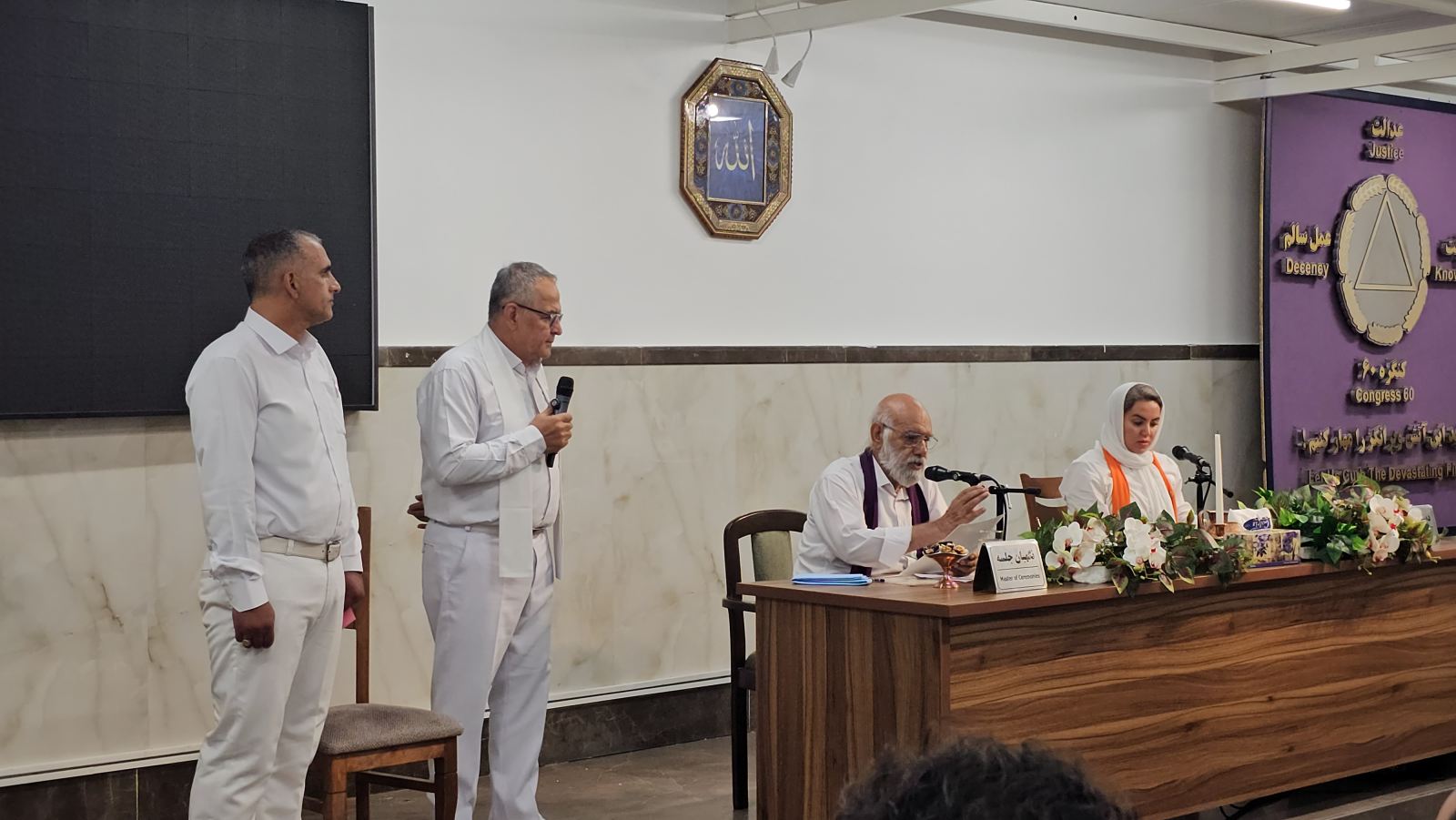
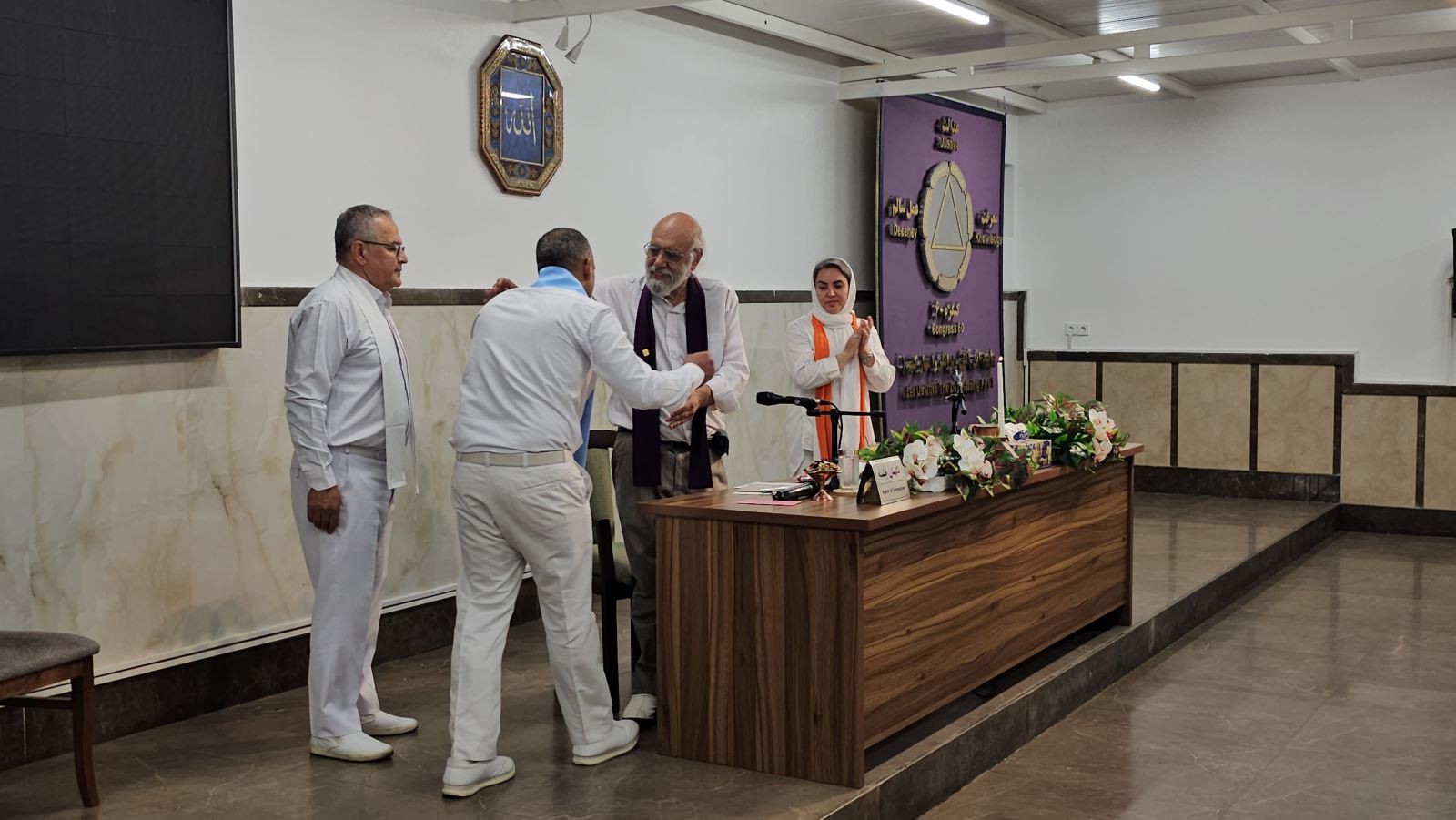
Mr. Dezhakam: We have an Assistant Didehban, Mr. Samiei. I’d like his Didehban, Mr. Majid Salami, to come forward. [This is part of the Covenant Ceremony, a formal ceremony in which members take an oath of service and receive their official shawl.] Please give them a round of applause.
Mr. Salami: Hello friends, I am Majid, a traveler. I would like to thank Mr. Dezhakam for letting us take up some of his session’s time. Today, we are here to introduce our dear Mohammad, who has been appointed to the position of Assistant Didehban with the Didehban Council’s vote and Mr. Dezhakam’s approval. Indeed, service positions are both learning opportunities for us and platforms where we can grow. I hope our dear Mohammad makes the absolute best of this opportunity that God has granted him. The Assistant Didehban serves as the assistant to the liaison Didebans of the branches. Just like the work I do in Isfahan and Shahrekord provinces, our dear Mohammad will also do the same, visiting and overseeing the branches.
Mr. Dezhakam: Hello friends, I am Hossein, a traveler. When individuals are considered for selection as an Assistant, they submit a resume, and this is Mohammad’s resume: He has served as a DST guide at the Ouman Samani Branch and led 63 people to liberation from addiction. As a William’s Legion guide at the Ouman Samani Branch, he has led 37 people to liberation from nicotine consumption. As a DST guide at the Boroujen Branch, he has led 44 people to liberation from addiction. As a William’s Legion guide at the Boroujen Branch, he has led 15 people to liberation from nicotine consumption. As a DST guide, 9 of his students have gone on to become guides themselves. He has trained two male companion guides, 3 newcomer traveler guides, and 1 newcomer companion guide. His total number of DST liberations is 107, and his total number of liberations from nicotine consumption is 52. Then his behavior and conduct were evaluated, and the Didehban Council voted in favor of his selection. This means that those who are chosen are not selected because of friendship or family ties. It is based on the resume that is submitted to us.
Mr. Salami: Thank you so much, and I truly appreciate Mr. Dezhakam, his respected family, and Congress 60 for creating the framework and structure that allows us both to serve and to learn. Thank you. Many thanks.
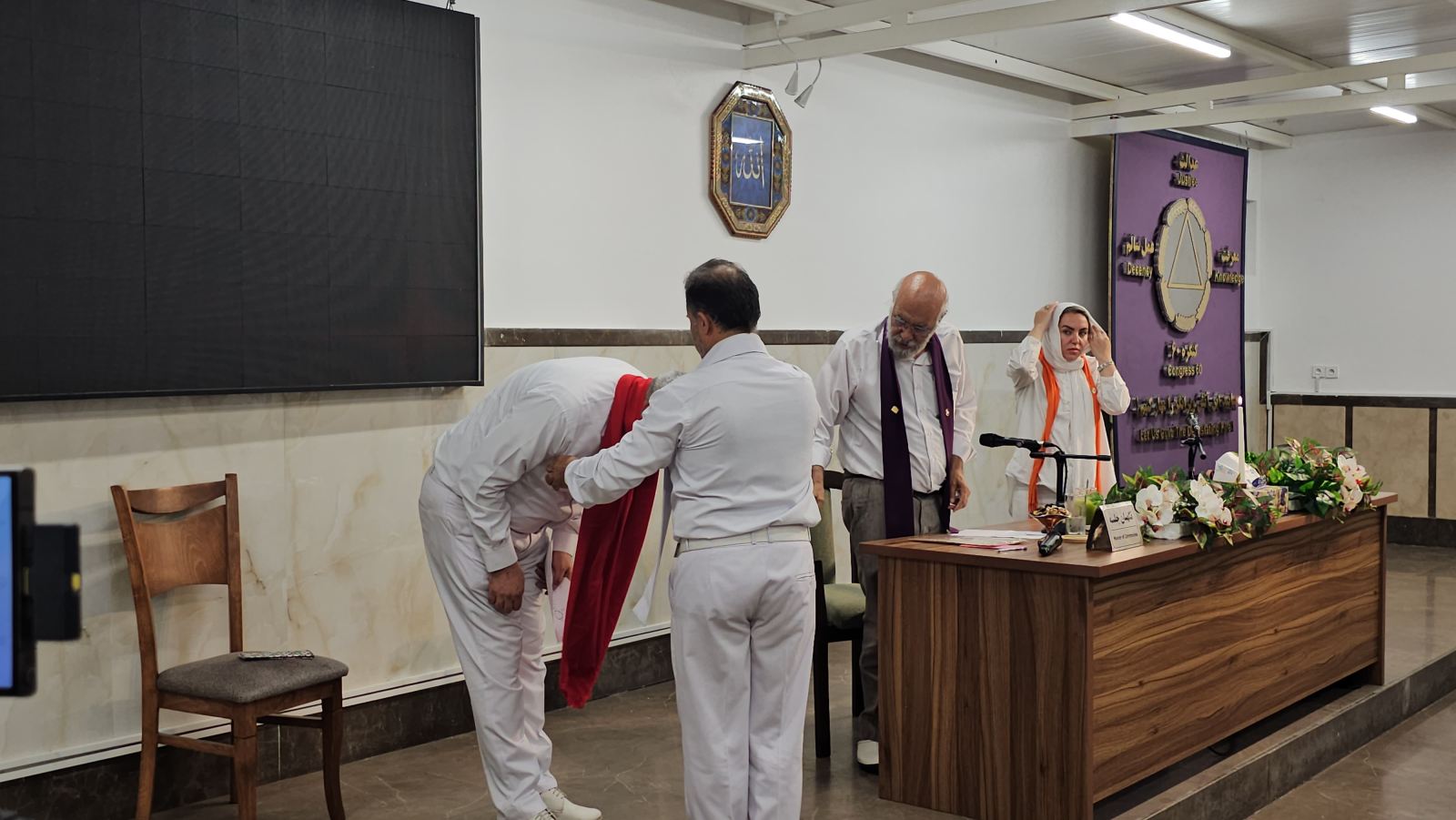
Mr. Dezhakam: We have an Assistant shawl presentation for Mr. Javad Sajjadi. May his Dideban, Mr. Alireza Zarkesh, please come forward.
Mr. Zarkesh: Hello friends, I am Alireza, a traveler. I congratulate our dear Javad on this day. During Golrizan (money donation) Week, we take a financial action. However, throughout the year, we sit in the Sardar Legion and discuss the process behind it. This change requires a transformation—a "becoming"—which is impossible without information and awareness. When we take a step or perform a service, if we do not receive training, we become entitled. I might say, “I paid 600 million Tomans to become a Pahlevan,” or “I paid 6 million Tomans to become a Sardar [these titles—Sardar, Donor, and Pahlevan—are the titles in Congress 60 awarded for financial contributions that support scientific research and the development of new branches, a person is entitled as “Sardar” when they donate 100 dollars, as “Donor”, when they donate 1000 dollars and “Pahlevan”e when they donate 100000 dollars]—so I am doing Congress 60 a favor.” But in the Sardar Legions, we sit together every 45 days under the framework of Congress 60’s teachings to understand this process. The pillars of teaching and knowledge belongs to the Base of Congress 60, Mr. Hossein Dezhakam. None of us stand in a position of knowledge, but we can share our experiences from the Sardar Legion with one another, discussing what we experienced as this process unfolded [This “experience” refers to one of the three sides of the Triangle of Cognizance: teaching, thinking, and experience]. This is exactly what an Assistant Didehban facilitates. Again, I congratulate Javad. He will attend the legions in Khorasan Province to discuss this process and Mr. Dezhakam’s CDs so that we know what we are doing. Once you understand this, everything changes. You no longer make the irrelevant excuses typical of a first-trip pupil—such as refusing to take your OT because "things are bad" or "it is dark," or withholding your financial commitment due to minor price fluctuations. Instead, you hold yourself accountable to your pledge, doing your best to fulfill your commitment. I congratulate Javad and wish him success.
https://search.eitaa.com/?url=https://www.congress60.org/News/502701/%DA%A9%D8%A7%D8%B1%DA%AF%D8%A7%D9%87-%D8%A2%D9%85%D9%88%D8%B2%D8%B4%DB%8C-%D8%AC%D9%87%D8%A7%D9%86%E2%80%8C%D8%A8%DB%8C%D9%86%DB%8C-%D9%88%D8%A7%D8%AF%DB%8C-%D9%BE%D9%86%D8%AC%D9%85-%D9%88-%D8%AA%D8%A3%D8%AB%DB%8C%D8%B1-%D8%A2%D9%86-%D8%B1%D9%88%DB%8C-%D9%85%D9%86
Translated by: Companion Samira, Legion 7, Sheikhbahaei branch of Congress 60, Isfahan, Iran


Revised by Elahe