The short report of the article on the treatment of multiple sclerosis (MS) with OT (Opium Tincture) has now been made available through Harvard University's library discovery system, marking yet another significant achievement by the Congress 60 research team.
Harvard University, the oldest institution of higher education in the United States and one of the world's most prestigious universities, has included the article entitled " potential Myelinogenesis effects of taper up-off of opium tincture in rodent model of multiple sclerosis" in its library platform. The article had previously been indexed in the Journal of Neurology, Neurological Science and Disorders and is now discoverable through Harvard University's library system, making it more accessible to researchers worldwide.
We extend our heartfelt congratulations on this significant accomplishment to all members of Congress 60, the organization's research team, and especially to the distinguished researcher and visionary, Mr. Hossein Dezhakam, whose pioneering work continues to advance scientific knowledge.
Abstract
Multiple Sclerosis (MS) is one of the most common demyelinating autoimmune diseases that affects the central nervous system and is characterized by major immune-mediated myelin and axonal damage or axonal loss explicable to the absence of myelin sheaths. Here we present the early findings of the gene expression study of myelinogenesis-related genes of MS rat models which were treated with a novel protocol of taper up-off of opium tincture.
The study included normal Lewis rats, MS rat models by induction of experimental autoimmune encephalomyelitis (EAE) without treatment, and MS rat models with a novel protocol of taper up-off treatment of opium tincture called Dezhakam-step-time (DST) in different dosages. RNA was extracted and cDNA was synthesized from the spinal cord tissue. Gene expression analysis was conducted for eight genes as markers of myelinogenesis (OLIG1, OLIG2, MBP, MYRF, PLP1, PMP22, EGF, and UGT8) using the Real-time PCR.
All eight genes were down-regulated in EAE models vs. healthy controls and all eight genes were up-regulated after the taper up-off treatment of opium tincture. The most over-expression of myelinogenesis-related genes was revealed at higher dosages of opium tincture.
These are the early results of a gene expression study in a multiple sclerosis model treated with opium tincture. It seems that the opium tincture method may induce the activation of myelinogenesis in EAE models which could lead to a potential treatment for improvement of neural dysfunctions in MS patients.
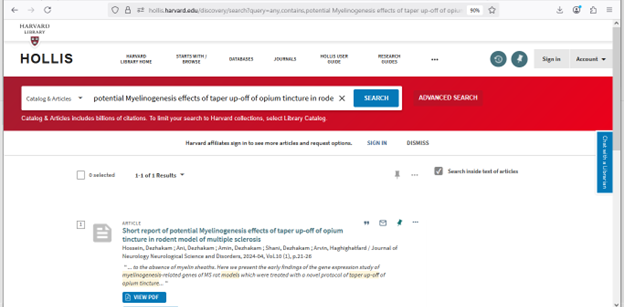
To view the article through Harvard University's library discovery system, please visit the following link:
https://hollis.harvard.edu/discovery/fulldisplay?vid=01HVD_INST:HVD2&tab=Everything&docid=crossref10.17352%2Fjnnsd.000060&context=PC&search_scope=MyInst_and_CI&lang=en